

What Goes Into the Price of a Garment?
As kidswear manufacturers, The first question we get from new clients is usually: "Can you make this?" And the second, almost immediately after: "How much will it cost?"
Both are the right questions to ask. In today's economy, we know that our clients are watching their margins carefully, and their customers are equally price-conscious. But nobody wants to compromise on quality. That's the tension every boutique brand lives with, and it's why we think it's important for you to understand what actually goes into the cost of a garment. When you know where the money goes, you can make smarter decisions about design, fabrics, and construction without sacrificing what makes your collection special.


Fabric is the biggest single cost
Fabric typically accounts for 30 to 40% of the total garment cost. But "fabric" isn't one simple line item. The cost varies based on:
-
The type of fabric (a basic cotton poplin costs less than a premium linen or an organic muslin). Using silk or linen could push the fabric cost up to 50% of the total cost.
-
The weight and weave (heavier fabrics and specialty weaves cost more)
-
Whether it's a stock fabric or a custom development (custom prints and custom-dyed fabrics carry development costs and higher minimums), and
-
Certification (GOTS-certified organic fabrics cost more than conventional equivalents, partly because of the certification process itself).
Here's something that catches many new brands off-guard: fabric pricing is heavily influenced by quantity. If you're ordering enough fabric for 30 garments, you're paying a different price per metre than someone ordering for 500 garments. This is one of the reasons why your per-piece cost drops as your order size increases. The garment itself hasn't changed, but the fabric economics have.
Labour isn't just "stitching"
When people think about the labour cost in a garment, they tend to picture someone at a sewing machine. But the labour component covers a lot more than that.
It includes pattern making and grading across sizes, cutting (which requires precision, especially when matching prints or plaids), stitching and construction, any handwork like embroidery, smocking, or hand-finishing, pressing and finishing, and quality inspection at multiple stages.
%20(1500%20x%20800%20px)%20(3)_edited.jpg)
Small batch orders will require each garment to be cut by hand.
A simple cotton romper with minimal construction might take 3 hours to produce. A hand-smocked bishop dress with French seams, lace insertions, and embroidery could take 2 days when you factor in the hand work.
The complexity of the design directly drives the labour cost. And, unlike fabric, labour costs don't reduce much with larger orders because each garment still needs the same amount of hands-on work.
This is especially true for handwork. A hand-smocked panel takes the same amount of time whether you're ordering 30 dresses or 300. The artisan still stitches every pleat by hand. There are no shortcuts and no machines that replicate the quality. That's why handcrafted pieces carry a premium, and why that premium is justified.
Trims and details add up faster than you'd think
Buttons, laces, ribbons, labels, hang tags, wash care labels, elastic, thread, zippers, custom branded packaging. Individually, each trim is a small cost. Collectively, they can account for 2 to 10% of the garment price.
The difference between a basic plastic button and a mother-of-pearl button that needs hand sewing might seem trivial, but multiply it across every button on every garment in a 200-piece order and the numbers shift. Same with lace: a simple cotton lace is very different in cost from a specialty crochet trim or a Chantilly lace.
We always break down trim costs separately in our quotes so you can see exactly where your money is going. If you have a cost target to meet, share it with us. We'll suggest alternatives that achieve a similar look while keeping you within budget.

Construction complexity matters
Two dresses made from the same fabric can have very different costs based on how they're constructed.
A simple A-line dress with a straight hem, no collar, and elastic casing at the neckline is a fast, efficient garment to produce. Now, add a Peter Pan collar, French seams instead of overlocked seams, a full lining, pin tucks down the bodice, and a sash with a bow at the back, and you've added significant labour time without changing the fabric or the silhouette.
Here’s a (non-exhaustive) list of construction details that increase cost:
-
French seams (where the raw edge is enclosed, creating a clean, premium finish)
-
Pin tucks and pleating (each fold needs to be measured and pressed individually)
-
Lace insertions (where lace is sewn between panels of fabric rather than layered on top)
-
Cloth-covered buttons (versus standard buttons)
-
Full linings (effectively doubling the fabric and stitching)
-
Can-can or net underlining for skirts (adds volume and construction time).
None of these are unnecessary costs. They're the details that make a garment feel premium. But it helps to know upfront which details drive the price so you can make intentional choices about where to invest.
Why made-to-order costs more than off-the-shelf (and why it should)
If you've browsed wholesale sites selling ready-made smocked dresses at low prices, you might wonder why a made-to-order garment from us sometimes costs more. The answer comes down to what you're actually getting.
Off-the-shelf wholesale products are produced in large volumes using standardised designs. The manufacturer makes one design decision and replicates it thousands of times across a single production run. Fabric is bought in bulk at the lowest possible price. Sizes are generic. Construction is optimised for speed, not for detail. And crucially, the design isn't yours. Any other boutique can buy the same dress from the same supplier.
When you commission made-to-order clothing, you're paying for exclusivity (the design is yours alone), custom fabric sourcing (the exact fabric you want, not whatever was cheapest in bulk), your size specifications (not generic sizing), construction to your quality standards (not the manufacturer's default), and the ability to modify, evolve, and reorder on your terms.

Made-to-order is more expensive per piece because it's a fundamentally different product. You're not buying a garment. You're building a brand asset that no one else can replicate.
Sampling is a separate cost
Some manufacturers roll sampling costs into the production price. We don't. We charge for samples separately, and here's why: a sample is a piece of custom development work. Our team is creating a pattern, sourcing fabric, constructing the garment, and refining it based on your feedback. That takes skill and time.
Charging for samples also means you're not locked into a production commitment before you've seen and approved the physical garment. You can order samples, evaluate them, and then decide whether to proceed to production.
Typical sample costs for a simple shirt in a non-custom fabric with no handwork component would start at around USD 20-22 . More complex pieces with handwork will be higher- USD 30 to 40. Shipping costs are extra. We provide a clear quote before starting so you know the total cost upfront.
Shipping and customs
Your garment cost doesn't end when production is complete. It needs to get to you, and the cost of getting it there is an important component of your overall pricing.
We ship via UPS and DHL for air freight and can arrange sea freight for larger orders where cost efficiency matters more than speed.
One thing many brands overlook when budgeting is customs duty or tariffs. The duty or tariff you pay on imported garments is determined by your country's trade policies, and it varies significantly depending on where you're based, how the garment is classified, and whether any trade agreements apply. It's not something we control, but it's something we can help you prepare for. We ensure all documentation (invoices, HSN codes, certificates of origin where applicable) is accurate and complete so your shipment clears customs as smoothly as possible.
We always include shipping estimates in our initial quote so you can factor the full landed cost into your retail pricing from the start.
So what does this actually look like?
To make this concrete, here's a simplified comparison:
Garment A: A simple woven cotton bubble romper
A sleeveless bubble romper in a single-colour cotton. Button-down, snap closures, minimal construction. No handwork, no embellishment. A straightforward garment that's quick to cut, stitch, and finish. This is the kind of piece that forms the everyday core of a baby collection.

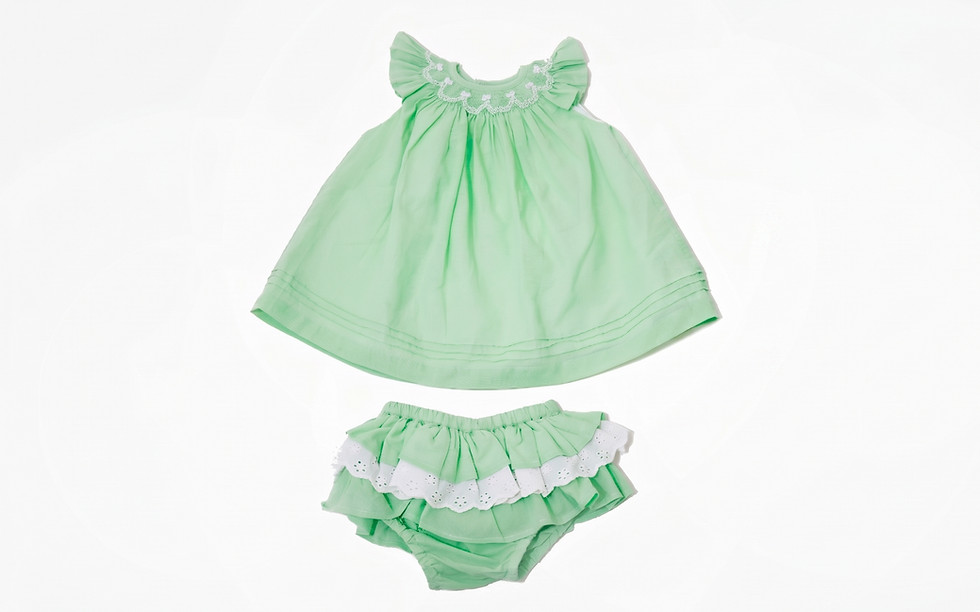
Garment B: A smocked dress and bloomer set with embroidery and lace
A two-piece set in the same weight of cotton. The dress has a smocked neckline with hand embroidery, flutter sleeves, and pin tuck detailing at the hem. The matching bloomers have a tiered ruffle with eyelet lace trim. Every element, the smocking, the embroidery, the pin tucks, the lace insertion, adds labour time and material cost.
Both garments use a similar base fabric. The per-metre fabric cost is comparable. But Garment B takes 4 longer to produce than Garment A because of the handwork, the construction details, and the additional components (separate bloomer piece, lace trim sourcing, smocking and embroidery time). That difference in time and skill is where the price gap comes from.
It’s not that one garment is overpriced compared to another. They're just different products requiring different levels of craft and attention.
How we quote
We provide detailed quotes before any work begins, with a clear breakdown of what you're paying for. If you need options at different price points, we can provide those too, giving you the flexibility to choose the right balance of design and cost for your collection. We'd rather have an upfront conversation about pricing than deliver a surprise at the end.
